Wakings Dreams and Warrior Women
Dr. Deluca-Verley was celebrated for her appreciation of the need for someone facing a devastating physical diagnosis to quicken/mobilize their spirit to face such a tough ‘hit’.
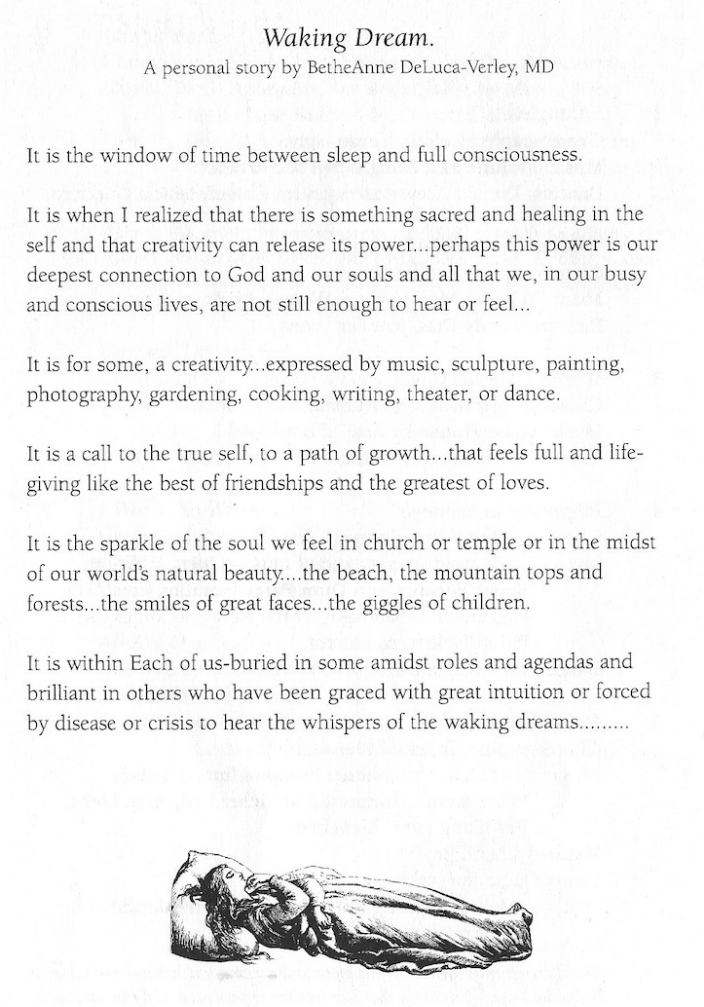
She co-founded Wakings Dreams and Warrior Women, which was featured in the national media. This is her poem, waking dream. The movement, Spirituality and Medicine, is now accepted in medical schools, as an essential dimension of care and formation of caregivers.
Excerpts from Chapter 19 – ‘Waking Dreams’ the Arts :
a Nondenominational Tool for Reconnecting Spirituality and Medicine, by BADV
of A TIME FOR LISTENING AND CARING, by Christina Puchalski, MD, et al
p. 300: Art seems to resonate with a yet undefined, fundamental energy of life that is not only timeless but also transcendent and universal. Art stirs us in a place within our bodies, tapping our dreams, our imaginations, and our prayers.
pp. 302-303: I was 37, still breastfeeding my third child and celebrating the opening of my solo practice in pediatric and adolescent medicine and teaching as a clinical faculty member at Brown University Medical School, when my life took a dramatic turn.
I found a lump in my breast, which proved to be malignant, along with nine lymph nodes. Due to the aggressive nature of my premenopausal cancer, I saw my colleagues’ faces drop as they laid out my treatment options. Several nights later, as I struggled to find some comfort from sleep, I found myself having a ‘waking dream.’ There in the darkness of my room, with my young family asleep, an odd notion kept pressing me to rise and dance.
I recall that my medically trained mind hammered off thoughts that this was ridiculous to consider dancing … since I needed many surgeries, intensive chemotherapies, radiation, major luck, and prayers to beat the poor prognosis laid out before me. Nevertheless, this notion persisted, until I thought, “What do I have to lose?” Since I had not danced in nearly twenty years – I had actually stopped dancing to pursue medicine – it seemed strange that a part of me, so long forgotten, reared up as a pathway to explore my illness.
That night, I went to the other end of the house and put on some music and danced in tears. My dancing eventually gave way to an internal shift. In those hours as I danced, I met my fears and my pitiful loss of control – the control I had worked so hard to master. Within that space of awareness or some strange sense of knowing, I felt un unbelievable urge to dance and then cry and then dance and then collapse into a place within myself. It felt like I was falling into what I called deep, dark spirals, where I had the sense of falling inward.
I wanted to extend apologies to those I felt I had wronged. So, during those wee hours of the morning, while my family slept, I sat with pen and paper and wrote letters of forgiveness from my heart. I felt so very much at peace, so full of compassion for myself and others who I had strained so hard to understand for so long. I recall feeling an opening through which my essential Self rose along with the rhythms of the music – feeling in unison with something far greater than myself – no longer alone. I felt well connected and energized for what was to be a long, intensive period of treatment for my aggressive form of breast cancer. I realized that no matter what this disease did to me, inside, my essential Self would always be there. To feel my body moving to the rhythms of the music reassured me that I was still quite whole indeed.
p. 305: Our group (WDWW) brings people together within a shared creative process in order to awaken new ways to view and confront their illnesses. How do we do this? We use the transformative art experience in a process focused on improving the quality of life, one moment at a time. There are also hundreds of hospitals throughout the country with artists – in – residence programs, healing arts programs, and arts coordinators who manage hospital art collections and who organize artists to be available to work with patients. The arts are used for their own transformative power rather than for diagnosis, treatment, or interpretation, acknowledging that treatment does not always mean a cure. Waking Dreams has been in the forefront of this movement, examining the meaningful collaboration of the arts within the framework of traditional medicine. We attempt to give all those involved, on both sides of the collaborative healing relationship – patients, families, and healthcare givers – a forum or platform in which to express emotions. These emotions – pain, disappointment, anger, and sadness – reflect one’s spiritual views about life, illness, judgement, death, and the afterlife.
p. 317: Art is not limited to those trained in extensive study of these media but rather as a window into the soul. Art, within the context of our discussion, is more process related than product related. Ironically, however, the products created within this realm of illness and impending death ring so purely with the courage and strengths of the human spirit that we are often overwhelmed by the beauty of the truths and the honesty that are inevitably revealed.